The Hayward Annual 1978: Addressing Gender Imbalance in British Art

Below is an adapted version of a paper I presented at Coventry University’s ‘Research in Progress’ seminar on January 9th 2019.

1

The Hayward Annual 1978 was held between 23 August – 8 October and was the first group exhibition of its kind to assess and critique gendered imbalances in the landscape of British art in the seventies. 1978 was the second year of the Hayward annual, with this edition selected by a panel of five women artists – Liliane Lijn, Tess Jaray, Kim Lim, Gillian Wise Ciobotaru and Rita Donagh. The second Hayward Annual thus became somewhat mistakenly known as “The Women’s Show”. This dubbing as an exclusively female exhibition occurred even though 30% of exhibited artists were male – a much higher percentage than was usually afforded to female artists showing in group exhibitions in this period

In America the seventies were a decade of progress for the Women’s Movement, with women’s art groups beginning to question and protest the art historical canon. For example, Judy Chicago and Miriam Schapiro’s seminal art project Womanhouse opened in Los Angeles in 1972, drawing attention to feminist issues within art institutions. These feminist ideas and institutional critiques from the American Women’s movement were however much slower to spread to Britain. I’ll now discuss some of the context in which the Hayward Annual of 1978 sits, highlighting why it was so significant as a moment of re-assessment and change in British art history.

The late 1970s and early 1980s saw the formation and championing of a prominent quasi-art-movement known as New British Sculpture. The term was applied to a diverse group of young, British, predominantly male sculptors, whose work, though visual disparate, reacted to the minimalist forms of the 1960s by returning to a focus on the materials and processes used in creating sculptural objects.

Many of the figures linked to this moment in British art were represented by the Lisson Gallery, an institution that was pivotal in the group’s promotion as a dominant art historical brand. Lisson Gallery owner Nicholas Logsdail used his position as a prominent figure in the art world to nurture the careers of this new generation of young and ambitious artists, ensuring their continued success. Further key organisations such as the Tate Gallery, the Arts Council and the British Council, were also supportive of this new style of sculpture, thus enabling the work of the artists associated with it to be seen in major institutions both in the UK and internationally.

The early 1980s thus saw several significant surveys of the New British Sculpture artists including: Objects and Sculpture at the Institute of Contemporary Arts and the Arnolfini (1981) and Figures and Objects: Recent Developments in British Sculpture at John Hansard Gallery (1983). Such group exhibitions were crucial in the promotion of these artists and worked as a tool for drawing wider public attention to their work. In 2015, Jon Wood commented that: “Objects and Sculpture did much to set the scene, critically and curatorially, for greater consideration over the next few years of individual artists’ works and for further discussion of the potential characteristics of the ‘New British Sculpture’.” It is worth noting that Objects and Sculpture included the work of seven male artists and just one female artist, while Figures and Objects included the work of six male artists and three female artists.

During this period of British art, New British Sculpture, or “the Lisson Boys” as they were sometimes dubbed, was the context within which other artistic pursuits were examined.

Within the proposal for the 1978 Hayward Annual it reads: “it was felt that a show chosen by five female artists would bring to the attention of the public the quality of the work of women artists in Britain in the context of a mixed show. It is in fact precisely in the context of mixed shows that women artists have been overlooked.”

2

The document then goes on to list some statistics of recent mixed exhibitions. Crucially, in 1975 the Arts Council exhibition Condition of Sculpture at the Hayward Gallery represented the work of thirty seven men and four women, prompting protests from feminist groups that demonstrated outside, demanding equal representation of women artists, as well as equal representation of women on selectors panels.

The 1978 Hayward Annual being selected by the all-female panel came as a direct result of frustrations with the male dominance within the British art world at this time. Sculptor Liliane Lijn, motivated by the complete lack of women artists who had shown at Tate, first proposed an exhibition of five women artists to show there. Tate ultimately rejected the all-female exhibition, deeming it “not feasible”.

Spurred on by the feminist protests surrounding the Hayward’s Condition of Sculpture, Lijn then proposed a show of contemporary British art to compliment the American loan exhibition Women Artists in 1550-1950, which was under Arts Council consideration for a London showing. Women Artists in 1550-1950 had been organised by Ann Sutherland Harris and Linda Nochlin, whose pioneering essay “Why Have There Been No Great Women Artists?” was first published in America in 1971. The exhibition has been described within contemporary curatorial theory as “by far the most significant curatorial corrective in the USA in the 1970s to the occlusion of women as cultural contributors from the larger historical record”. Despite the prestige and influence of this show, it was ultimately rejected in London and as was, by association, Lijn’s proposed contemporary British art show. Instead, Lim, Jaray and Wise Ciobotaru soon joined Lijn to submit a proposal for an exhibition of contemporary British Art, with themselves as the selection panel. This time they were successful, and thus the second Hayward Annual became the first Arts Council sponsored exhibition in Britain organized by women and showing predominantly women’s work.

Speaking retrospectively in 2018, Deanna Petherbridge, one of the exhibited artists in this show, noted the fear women artists felt during this period, explaining that: “it was a fear imposed by the masculine power of the moment, that we would just be ridiculous, we would just be women.” Petherbridge expands on this, stating: “there was a rhetoric about it and this was absolutely about social meaning in the art world, that women were excluded.” The second Hayward Annual was therefore a timely and much needed corrective to this male dominance in the British art world, as well as the slow beginning of institutions changing and opening up to art outside of the white male canon.

3

It is worth here briefly noting the first Hayward Annual, held in 1977 which was selected by curator Michael Compton, painter Howard Hodgkin and sculptor William Turnbull and showed the work of just one female artist and twenty-nine male artists. Compton blatantly described the selectors’ criteria for the 1977 show as artists “within our knowledge and prejudices”.  As the first annual representation of current British art at the Hayward, it is extremely telling that the selecting panel, who agreed that all decisions should be unanimous, could not find more than one female artist that they deemed worthy enough of including within the exhibition. The sculptor Kim Lim was the only woman artist to be exhibited at the first Annual and was also the only non-white artist in the show. Lim was married to selector William Turnbull…

Four out of five of the selectors for the second Annual showed their own work, the exception being Kim Lim who, as she was already showing work in the first Hayward Annual, the gallery felt should not exhibit in two successive Annuals. Andrew Demsey, the Assistant Director of Exhibitions, cites the reason for Lim not showing at the Hayward for a second year running as: “exhibiting space of the kind we have been able to provide for the artists in the 1977 Annual is all too rare in London and we are anxious that as many artists as possible should have the opportunity to exhibit in the series.” It is rather ironic that a female artist, and one of the driving forces behind an exhibition re-assessing the opportunities available to female artists, should be denied such rare exhibiting space within a show selected by herself and her colleagues. This was to Lim’s detriment as her work was not only excluded from the exhibition itself, but also from the significant catalogue that was produced to accompany it, within which all the other selectors were represented.

Though the resulting exhibition was made up of 70% female exhibitors, it did not overtly address issues relating to women’s experiences, nor express a distinctly feminist viewpoint. Lilian Lijn stated that : “the issue is not so much women’s art  (in fact not at all) but equalising the representation of female artists in mixed shows”. This demonstrates that the 1978 Annual was not intended to be a feminist exhibition, nor the “women’s show” it would later become hailed as.

The intention was not to separate women’s practice from the mainstream, but rather to highlight it within the context of (typically male dominated) contemporary British art. When describing the selection process for the Hayward Annual, Tess Jaray noted that initially each member of the selection panel chose two artists – either two women or one woman and one man. She commented that: “we wanted to look at the differences, if indeed there were differences, in the art made by men and women”. However, Jaray commented in a recent panel on women in today’s art world that critics of the 1978 Hayward Annual “didn’t know how to deal with it and in the end it just got called ‘The Women’s Show’.”

The group exhibition that emerged from this selection process was a diverse presentation of painting, drawing, photography, installation and sculpture, with no obvious connecting thread running through the almost 200 works on display. This was in keeping with the criteria of the Hayward Annual series which aimed to “present a cumulative picture of Britain’s art as it develops” and also “reflect the judgement of the selectors for that year”. All five gallery spaces, as well as the two outside sculpture courts, were used for the exhibition. There was also an “Open Space”, programmed with performances, discussions and installations. Though this space was heavily programmed, it has been rarely discussed in contemporary analysis of this exhibition, given that the events and performances were not recorded.

The titles of the press reviews for what was ostensibly believed to be a show of entirely women’s art were frequently mocking and belittling – for example “Wayward Gallery”, “Women’s Work” and “Ladies Night at the Hayward”, to name a few. Several such titled articles were published prior to the exhibition even opening. It is interesting to note this immediate dismissal and ridicule within the media when the historically established male-to-female ratios in a collective survey exhibition were flipped this way or when exclusively women were given the status of selector for such a high-profile art event. Despite these critical headlines, many of the reviews published once the show had opened were generally rather positive. John Russell Taylor’s “Ladies Night at the Hayward Gallery” column for The Times which began with the provocative line: “This year the Hayward Annual has been taken over by the women”, later admits that: “there is a very consistent level of achievement in the show, with no sign of lame ducks who have got in only because it is ladies’ night.”

3

Within Francis Spalding’s review of the exhibition, she called it “one of the most exciting exhibitions of modern art for some time”, noting in particular the “feminine sensibility” to be observed in the work on display. This is echoed in Paul Overy’s Time Out review, titled ‘Women’s Work’. Overy states:

Feminists will probably object to that phrase ‘feminine sensibility’, but I use it descriptively and not evaluatively. It characterises some of the most boring as well as some of the most interesting painting in the show. And, good or bad, it is a calm relief from the heavy, sweaty maleness of the work of many of the artists in last year’s Annual.

Lilian Lijn commented in 2018: “it did get a lot of publicity, even if the publicity was not of the kind we would have hoped for, but it was publicity and publicity always attracts people.”  In the pre-internet era, art criticism carried greater weight than it does today as it was the principal way for audiences to find out about exhibitions and artists. The sheer number of reviews for the second Hayward Annual is very impressive; it is unlikely that any London art exhibition today would receive quite this volume of press coverage. Over 26,000 people attended the exhibition in the six weeks it was open, a large number by the standards of visitors to contemporary art exhibitions at this time. The huge amount of press coverage, from a variety of publications across both the art and daily press, is likely to have had an impact on this visitor count.

The American feminist art commentator Lucy Lippard wrote the catalogue essay for the 1978 Hayward Annual. Commenting on the braveness of the selection panel, Lippard noted: “‘it has taken some courage to organise a mixed show while admitting to a bias in favour of women. All-male shows selected by all-male juries have never stated their prejudice so openly.” Interestingly, as pointed out publicly via the correspondence pages of Art Monthly, Lucy Lippard’s text for the catalogue was not authentically reproduced. Four out of the six paragraphs of the opening section on the background of the exhibition were omitted. Lippard wryly commented upon this: “I can only wonder at the extraordinary coincidence that the most ‘controversial’ paragraphs were so neatly omitted through a ‘printer’s mistake’”. Within these four paragraphs, which were absent from the first run of catalogues – including copies given to reviewers – Lippard expands upon the selection process of the exhibition, its intention as a mixed (rather than all-female) show and Lim’s lack of participation due to what she deemed the “arbitrary” rule introduced by the Arts Council. Had reviewers read Lippard’s essay in full, there may have been a greater understanding of the exhibition’s motivation and aims within the context of the emerging feminist art movement in Britain.


Review: Home Futures at The Design Museum

Last week, after spending six hours huddled over an archive file at the store in Blythe house, I emerged into a surprisingly dark and wet London (it had been relatively bright and breezy when I arrived for my archive appointment). I don’t often find myself in Kensington and had never visited the Design Museum before, but I’d heard good things about the Home Futures exhibition and knew I had 50% off entry with my student art pass so thought I’d head there to shelter from the rain before my train back to Coventry.

Greeted with the declarations “If you’re unsure of what you can and can’t touch, please just ask an exhibition assistant” and “You’re welcome to enter the hole in the wall, just take your shoes off first please.”, I was instantly made aware of the haptic and interactive nature of this exhibition, and curious to find out more. With over 200 interdisciplinary objects from the worlds of art, design, architecture, film and ephemera, presented across five themed rooms connected by a sprawling corridor, there is plenty to entertain the senses. The dream-like passages, which include a bed and a garden area were designed by New York based architects SO-IL and make for a unique and intuitive-feeling exhibition space.

hf

Many of the objects in the exhibition use sound, moving image and changing light. The overall feel is thus that of a sci-fi imagining of the future (think of the landscape of the original Blade Runner or The Fifth Element). Some, shorter sequence, sound pieces repeat themselves over and over again as you move through the space, chanting at you. The most visceral memory I’ve kept of this is Alexa’s helpful robot voice interacting with the sing-song tones of a housewife proclaiming her love for her automatic vacuum cleaner. Meanwhile some of the longer film pieces lure you in to sit and linger for a while – there’s a variety of kitsch seating provided for this from a Dali-esque lip sofa, to some seriously luxurious iridescent beanbags, to the aforementioned hole in the wall which was filled with pillows and changed colour in pulsing intervals.

Here are some of my favourite objects from the show’s many treasures:

hf1

This series of imagined internet routers of the future created by designers from Google’s OnHub Makers project – I loved the idea of a big furry WiFi beast in the corner of a living room.

hf2

The 1971 Pratone chair designed by Giorgio Ceretti, Piero Derossi and Riccardo Rosso, which you could sink right into, as demonstrated by the charming photograph of it being used by a group of children with bowl haircuts displayed behind it.

5116391_orig

Just what is it that makes today’s homes so different, so appealing? the 1956 collage by Richard Hamilton. I studied this image in the first term of my art history degree back in 2010 – so many of those big seminal works seem much smaller and more understated when you see them in person don’t they?

hf4

Kiki van Eijk’s 2018 textile series Software. Woven contemporary still life scenes which incorporate modern technology with everyday domesticity. These were so beautifully lit by that magical colour-changing hole in the wall!

And finally, a mock-up Ikea catalogue of the future, which visitors were allowed to take away with them. I laughed to myself on the train home browsing through such items as a living moss carpet and bedding that can adjust to your preferred “pillow fluff-factor”.

This was truly a delight of an exhibition. My only regret was that I had to leave the gallery at closing time, without enough time to finish watching the enthralling film of a Danish man’s discovery that his Airbnb guests had been wearing his wife’s underwear and posting images of themselves in it on Instagram with the hashtag “weird sex”.

A Note on PhDs and Mental Health

I’m back from Venice – it’s cold, it’s dark, my PhD office is heated only by a dodgy old storage heater that the facilities team regularly threaten to confiscate, no-one has sat at the vacant hot-desk on the other side of the room for months and there can be days where I go a full 24 hours without seeing anyone. November has been proving tough. Despite how much Vitamin D I try to to take and exercise I try to get, the seasonal depression is back and I’m struggling with it.

There’s also been a couple of setbacks with my PhD: an unsuccessful funding application, a useful archive that is “closed and inaccessible until further notice”, as well as a bout of writer’s block. It’s hard not to feel like these are problems I have to deal with totally alone, given the fact that as a PhD researcher I’m basically my own line manager and only I really know how the project is going. At my last tutorial, my kind, soft-spoken supervisor gently probed: “You seem very anxious and stressed”.

I’ve struggled with my mental health for a long time. I remember it first getting noticeably bad in 2010 when I started my undergraduate degree. Since then there’s been a few periods where anxiety has been absolutely at the forefront of everything I do, as well as times when it’s almost totally silent. This July I decided to stop taking the SSRIs I’d been prescribed a year prior to that and to try managing things myself.

While I stand by that decision (for me, for now) the pressure, self-direction and, let’s face it, loneliness of doing a PhD create a challenge.  Lately there are days when I don’t feel like getting out of bed – and in this kind of job I don’t actually have to. No-one knows if I’m sitting in my ice cube of an office finishing off a chapter draft or curled up in the foetal position watching true crime documentaries and eating toast. But then the days when I don’t feel I’ve achieved enough, that feeling of under-achievement manifests into thoughts of “I’m not good enough”, “I don’t deserve this opportunity”, “I’m wasting it”. This can lead to working through illness, losing track of a work/life balance and generally “wasting” more time wallowing in the anxiety of it all. It’s hard. And sadly I don’t have a nice neat conclusion to tie things up here – it’ll continue to be hard sometimes, and less hard other times.

me

I’ll put a couple of links to interesting things I’ve read about PhDs and mental health below:

More than one-third of graduate students report being depressed (2018)

Why studying for a PhD could be bad for your mental health (2017)

Dark thoughts: why mental illness is on the rise in academia (2014)

A Few Highlights from Venice

Two weeks ago, following a successful PRP and officially progressing into the second year of my PhD, I flew out to Venice for a month-long research fellowship, funded by the British Council. Out here I’m working at the British pavilion of the architecture biennale, conducting my own site-specific research project and absorbing as much art and architecture as I can. Here’s a list of a few of my favourite exhibitions and experiences so far.

  1. Paula Crown – ‘The Architecture of Memory’

Behind this doorbell at Studio Cannaregio is Paula Crown’s exhibition ‘The Architecture of Memory’. The first room is strewed with red cups, like the memory of a party the night before, though instead of plastic they are made of heavy plaster and each has been placed with purpose. Crown also produced a map of who each cup belonged to which made me think about the process of mapping and has inspired my research on the sculpture to be found in this city. I was the only visitor at the time and the exhibition felt like a hidden secret.

  1. ‘Memphis: Plastic Field’ at Palazzo Cavalli-Franchetti

I literally exclaimed “WOW” as I arrived at the entrance to this exhibition. The contrast of the bright, postmodern design with its sixteenth century surroundings is some very intelligent curating. I didn’t know much about the short-lived Memphis group before visiting this show, but I’m very glad I took a chance on this as it was gloriously kitsch and colourful – I now want to decorate my own home exactly like this!  Following the exhibition inside the palazzo, ticket holders could also visit Ai Wei Wei’s Gilded Cage in the courtyard and move through the turnstiles inside the sculpture itself – this was a really special experience.

  1. ‘The Explorers: Part 1’ at The V-A-C Foundation
RC_8669-Modifica-1600x1067RC_8745-Modifica-1600x1067These images courtesy of V-A-C Foundation Photo: Delfino Sisto Legnani and Marco Cappelletti

The V-A-C is free to enter, which is a big plus for me living in Venice on a PhD student budget. The current exhibition ‘The Explorers: Part 1’, curated by Whitechapel’s Iwona Blazwick, is well worth a visit. Throughout the galleries careful space and consideration has been given to each artwork on display, meaning that each room features just one or two works on a well co-ordinated colourful background, sometimes with soundscapes or an overheard film work from the next room. By far the highlight for me was the Francis Bacon painting which has been given its own soundtrack by Turner Prize nominee James Richards’ and ambient lighting, so that visitors can be fully immersed in their viewing of the work. I’ll definitely be back to visit this one again.

  1. The Vatican Chapels, Holy See Pavilion

I’m trying to visit as many free satellite pavilions from the biennale as possible. A couple of days ago I made the vaporetto journey out to San Giorgio Maggiore to experience the Vatican Chapels, which had been highly recommended to me by other research fellows. And I was not disappointed! I don’t claim to know much about architecture but am learning here to think of it as another form of sculptural encounter. The woodland of San Giorgio had become a kind of sculpture garden, dotted with ten contemporary chapels constructed by different architects. Despite not following any religion myself, I do often find the experience of entering religious buildings quite profound and this was very true of the chapels on this island. The weather in Venice is just becoming autumnal as the leaves here change and a soft breeze fills the air – this seemed the perfect time to visit to capture the golden light and shadow created by these buildings.

#AskACurator – A Rant

Before I took up my PhD studentship, I was (fairly desperately) job-hunting for a new curatorial role. I’d finished my MA in Curating in January 2016 to a job offer of a maternity cover position as Curator of Modern and Contemporary Art at a national museum, feeling fairly smug that I’d now “made it” and was on my dream career ladder heading towards curatorial success. Early into 2017 I came crashing down to the reality that gallery/museum work is extremely insecure and hard to break into, even with experience, qualifications and enthusiasm. My line manager at my previous role had told me that he hoped to be able to make me a permanent staff member but this came at a time of mass voluntary redundancy and funding cuts and was therefore not approved by Senior Management. My studentship interview thus came after months of temping, lengthy job applications and eight unsuccessful interviews for curatorial roles, the feedback of each (apart from one disaster one which I may go into in some future blog post) was “we really liked you, but someone else had better experience.” At this point I’d been so broken down by the process that I couldn’t quite believe it when my now supervisor rang me 10 minutes after the interview to enthusiastically offer me the position.

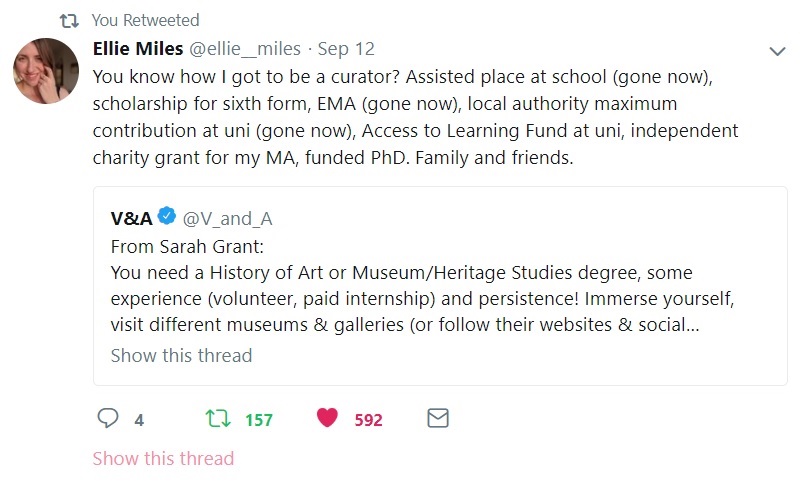
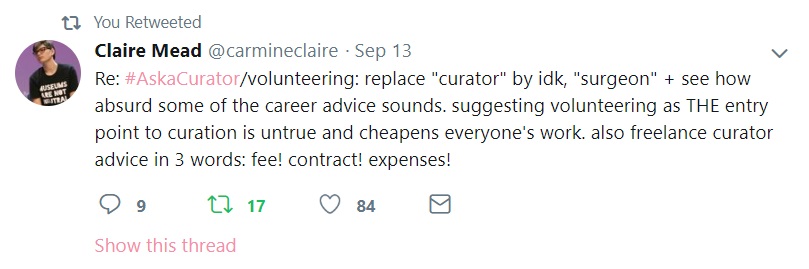
I, like many others, was therefore a little enraged by the recent “#AskACurator” discussion on twitter which highlighted volunteering and unpaid internships, as well as what can be very costly postgraduate courses, as the only way in to the increasingly competitive sector.

tweet onetweet two

Something really needs to change if this is true as it closes the door to many who simply cannot afford to work for free and/or fund further education. I had to move back in with my parents for six months during my job hunt, which is also just not a possibility for many people. I’m fortunate to now have funding for a three year PhD programme, which I’m hoping will further enhance my employ-ability and help me make more contacts, but again this is not a possibility for everyone. Such elitism and lack of funding opportunities or salaried work experience leads to a further lack of diversity within arts institutions which, lets face it, are already predominantly institutions run by (and often for) the white middle class.

Ellie Miles, a curator I came across through following this hashtag on Twitter, has written a good blog post on her experiences of this with some tips and resources here.

Is There a “Feminine Aesthetic?” – A Literature Review.

For almost the entirety of my first year, I’ve put off writing a literature review. I still struggle with thinking of myself as An Academic and for me, based on the kind of texts I like to read, a literature review just felt overly formal, forced and something that would interrupt the flow of my writing. I talked to my supervisor about this at length and she agreed that I could bypass this process if I really wanted to as an arts and humanities PhD is slightly different and conducted in a less formulaic way than science-based doctoral research projects.

Then I changed my mind.

Throughout the last twelve months of research I’ve returned again and again to this idea of a “feminine aesthetic” or “feminine sensibility” and whether or not this exists, either consciously or innately, within women’s art practice. This longstanding debate within art history was amplified by the political activism and institutional critique of the 1970s Women’s Art Movement in America, with the ideas slowly spreading into Britain too. Even today there is no conclusive agreement as to whether women make artwork in a fundamentally different way to their male counterparts or what the key features of a feminine aesthetic are.

The task I face in my literature review is to trace this debate from the 1970s to the present day, recording the different voices that have weighed in on the topic and shaped our understanding of it, such as: Linda Nochlin, Sarah Kent, Lucy Lippard, Judy Chicago and Luce Irigaray, amongst others. I’m beginning by making an Excel spreadsheet (one of my favourite things) ((seriously)) of all the reading I’ve done on the topic, so that the data is presented visually for me to analyse. I’ll then turn this in to the first chapter, which will be (hopefully) a solid foundation and starting point for the rest of my PhD thesis.

1f9d340d387fddd3c05d0a5600534865

Karla Black, At Fault (detail), 2011.

Karla Black on discussions of her artwork as conforming to a feminine aesthetic: “Why do people call it feminine? Because it is light, fragile, pale? Because it is weak, impermanent? When you start going to work on it you realise how ridiculous the description is. How can a work of art be feminine?” [1]

[1] Higgins, Charlotte. “Karla Black at the Venice Biennale: ‘Don’t Call My Art Feminine.’” The Guardian, May 31, 2011, sec. Art and design. http://www.theguardian.com/artanddesign/2011/jun/01/karla-black-at-venice-biennale.


A beginning

Subject to an impending annual Progress Review Panel (shortened to PRP, which I find hard not to say as a little “prrrp” sound effect in my head) I am about to commence my second year as a PhD researcher at Coventry University. The first year has been busy, challenging, fun, inspiring and, at times, hideously stressful.

As I move into second year I am focusing on writing my ideas down and sharing them with others – a little of which I’ll do informally here. It’s quite possible that no-one will read my thoughts on women’s sculptural practice and/or how weird doing a PhD is, but I think it’ll be a useful exercise for me anyway.

wednesdayarchives